Showing posts with label distance. Show all posts

Tuesday, February 25, 2020

The Triangular System of Planetary Motion

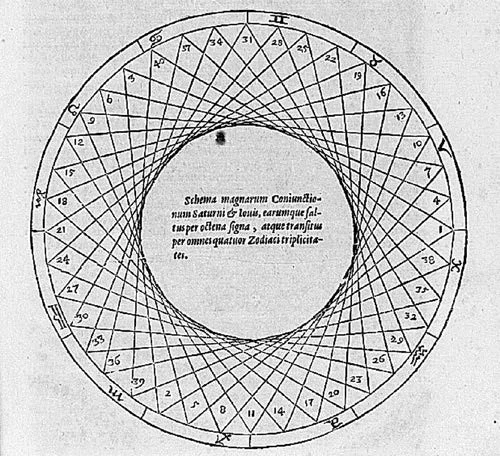
The solar system is a circular motion system , but as I will now demonstrate for the first time, the mechanism by which it's bodies move in relation to the Sun is based on the triangle. Kepler stumbled upon the idea that a trianglular mechanism governed how the planets moved in 1595 while in the middle of a lecture on the conjunctions of Saturn and Jupiter. Each set of three points he wrote on the blackboard corresponded to a conjunction and formed almost  precise equilateral triangles. These triangles rotated around the board to form two circles, with the radius of one half that of the other one, approximating to the distances of Jupiter and Saturn. 

Image result for kepler triangle saturn

Thus, a triangular pattern determined the distances between two planets moving with a circular motion. This may have something to do with the fact that a circle is constructed using three points just like a triangle. He was then inspired by this discovery to fit the five Platonic polyhedra solids into an arrangement that corresponded to the known distances at the time between the six known planets. His completed model was magnificent but a little bit on the complex side (and proven to be a failure over time). He actually missed out on something much more simpler and even more remarkable which I will now demonstrate. He could have realised this after 1619, when he discovered his third law but at that stage his focus had shifted to the musical harmony of the planets. 

Keplers Third Law states that :

𝞪

So if the distance of a planet from the Sun is doubled,

=

= 8

T = 8

The change in orbital period is the square root of eight or 2.82. The planet will take 2.82 times longer to travel around the Sun.

Now we can work out the change in velocity. Remember the formula speed equals distance over time from school ?


V = D / T

V = 2 /  8

V = 2 / 2.82

V = 0.707


Or we can use my own formula V = F. The change in the force of gravity when the distance is doubled is 1/2² or 25% . The double square root of 0.25 is 0.707.

So, to sum up when:

Distance = x 2

Orbital Period = 8

Velocity = 0.707 


The great beauty of these numbers is that they are represented perfectly by Pythagoras's Triangle. Once again, remember from school, the square on the hypotenuse is equal to the sum of the squares on the other two sides. If the two sides are both two, then the longer side (hypotenuse) is equal to the square root of  2² + 2², i.e.  8, thus representing the change in orbital period.


The connecting line between the 90 degree angle and the centre of the hypotenuse is equal to half of  8 or 1.41.

1.41 divided by the side representing distance 2, equals 0.707. Thus this centre line represents the change in velocity.

Incidentally, Sine 45 degrees also gives 0.707.

So, the solar system is not a complex polyhedral system as Kepler believed, but is actually governed by a much simpler triangular mechanism. The secret to the Harmony of the Planets and the Mysterium Cosmographicum lies not with Plato and his solids but with the first known Greek mathematician and philosopher, Pythagoras of Samos, and his right angled triangle.

Monday, July 29, 2019

The Harmony of the World Revisited - New Harmonious Ratios Revealed

400 years ago in 1619, Johannes Kepler published his third and most important law of planetary motion in Harmonices Mundi or Harmony of the World. The third law showed that there is a simple relationship between the time it takes a planet to complete it's orbit and the planet's distance from the Sun. The square of it's orbital period is equal (or proportional) to the cube of it's distance from the Sun. 


Kepler had proved that there was a Harmony or Logos (order) to the universe. He believed that "God wants to be known through the Book of Nature" and after his discoveries wrote "I found among the motions of the heavens the whole nature of Harmony". 


Newton used Kepler's third law as the groundwork to build on for his gravitational laws. Whilst Kepler looked only at the ratios of planetary motion, Newton's laws dealt with absolute values using values for G constant and mass. As such, Newton's equations tend to be a bit more complex to calculate. With Kepler's law, once you know the distance and orbital period of one planet, then you can work out what it will be for another planet in the same solar system (it also works for Jupiter and its moons).  The crucial thing about Kepler's third law is that the mass of the planets does not matter, Jupiter is subject to the same harmonious ratios as Mercury.


400 years after Kepler finally derived order from Tycho Brahe's enormous amount of data, I decided to take a fresh look at the motions of the solar system again to see if there were any more simple relationships between the elements of planetary motion - distance, orbital period and velocity. Were there any more relationships he had missed ?


During my research, I came upon two formulas, firstly one that encompasses all three planetary motions - orbital period, distance and velocity - into one single formula. And secondly, a formula that shows a very simple relationship between velocity and distance. I can find no reference online to any of these formulas, but if you know of any please let me know. As far as I can ascertain, this is the first time these formulas have come to light :

• Distance squared = Time / Velocity

Compare with Keplers law :

     • Distance cubed = Time squared   
   
Where distance is the distance from the Sun, Time is the time it takes to complete an orbital period, and velocity is the speed of the orbit. For both of the above formulas, the ratio of the motions between a pair of planets is used, rather than actual units of measurement as in Newton. The calculations below are very simple and anyone with basic mathematical skills can do them.

So, for Earth and Mars, Mars is 1.524 times further from the Sun and has an orbit period of 687 days or 1.88 times that of Earth. 

     •  Distance squared = Time / Velocity

1.524 sq = 1.88/V

2.322 x V = 1.88

V = 0.809


Earth moves at a velocity of 30km/s, 30 x 0.809 = 24.27 km/s for Mars, which is the correct velocity for Mars.

As with Kepler's law, my formula can also be used for the moons of Jupiter. The velocity of Io and Europa is 17.334 km/s and 13.74 km/s respectively, a ratio of 1.26157. The orbital periods are 1.7691 days and 3.551 days, a ratio of 0.498.

Distance sq = 0.498/1.26157 = 0.3947

Distance = 0.3947 = 0.628

Io is 421,700km from Jupiter, for Europa it's 670,900km, this works out at a ratio of 0.628.


The reason why this formula works is because as distance increases, the orbital period increases (hence why Time is on top of the fraction) and velocity decreases (hence why its the divisor on the bottom of the fraction). Nothing really challenging there but slightly harder to explain is why the relationship is based on the square of the distance. Newton, of course, found the same relationship between gravity and distance. It appears that gravity operates something like light and flux, as the distance from the Sun increases, the force decreases with the square of the distance, because gravity does not simply act between one point and another i.e the centre of mass. Rather it appears to act over the surface area of a sphere, the area of which is (4pi) radius squared (radius and distance are interchangeable in all planetary motion formulas).

As the size of the sphere increases, the force is distributed over a wider area and hence will be less and less, just like a balloon.

Relationship between Velocity and Distance


Kepler's second law showed that there was an inverse relationship between the velocity of a planet and its distance from the Sun. However, Kepler was referring to the trans-radial velocity of the planet, i.e. the minor changes in velocity as it approached or became more distant from the Sun. He never actually worked out a formula for the velocity of one planet in relation to another, although he possibly could have done from his third law.

By using a combination of my own distance squared formula and Kepler's third law, I arrived at :

• Velocity = Distance / Distance

Again, this shows an inversely proportional relationship. As the distance increases, the velocity decreases. Distance without the square root is on the bottom of the fraction because no matter how much the distance increases, the velocity will always work out smaller.

Uranus has a distance from the sun of 12.597 times that of Mars.

Velocity =  12.597 / 12.597 = 0.2817

Mars has a velocity of 24.07 km/s.

24.07 x 0.2817 = 6.78 km/s. 

Uranus indeed does have a velocity of around 6.8 km/s.

Mars is roughly double (2.1) the distance from the Sun as Venus.

Velocity =  2.1 /2.1 = 0.691

Venus has a velocity of 35.02 km/s.  35.02 x 0.691 = 24.19 km/s, which is the correct velocity for Mars. 

So when the distance is doubled, the velocity is reduced by about 30%. At the same time, the orbital period will increase like so :


     •  Distance squared = Time / Velocity


2.1 sq = Time / 0.691

Time = 4.41 x 0.691 

Time = 3

Venus takes 225 days to orbit, and three times that gives you  675 days, very close to Mars orbit period of 687 days.  

These simple formulas further support the notion that there is a harmony or Logos to the universe. The mechanism that governs the motion of the planets around the sun or the moons around Jupiter is one and the same simple mechanism following the same set of rules, differing only in magnitude because of the differences in mass between the central bodies of the Sun and Jupiter. I will examine this closer in another article.