Showing posts with label velocity. Show all posts

Tuesday, February 25, 2020

The Triangular System of Planetary Motion

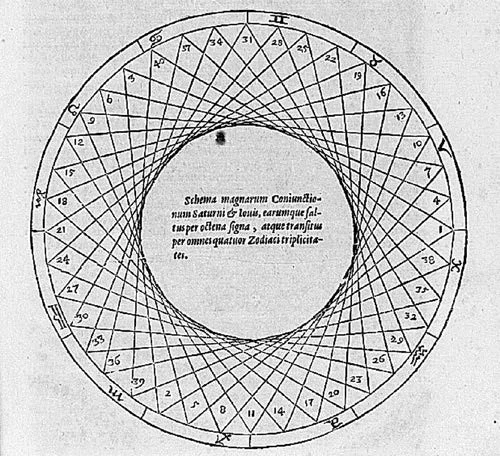
The solar system is a circular motion system , but as I will now demonstrate for the first time, the mechanism by which it's bodies move in relation to the Sun is based on the triangle. Kepler stumbled upon the idea that a trianglular mechanism governed how the planets moved in 1595 while in the middle of a lecture on the conjunctions of Saturn and Jupiter. Each set of three points he wrote on the blackboard corresponded to a conjunction and formed almost  precise equilateral triangles. These triangles rotated around the board to form two circles, with the radius of one half that of the other one, approximating to the distances of Jupiter and Saturn. 

Image result for kepler triangle saturn

Thus, a triangular pattern determined the distances between two planets moving with a circular motion. This may have something to do with the fact that a circle is constructed using three points just like a triangle. He was then inspired by this discovery to fit the five Platonic polyhedra solids into an arrangement that corresponded to the known distances at the time between the six known planets. His completed model was magnificent but a little bit on the complex side (and proven to be a failure over time). He actually missed out on something much more simpler and even more remarkable which I will now demonstrate. He could have realised this after 1619, when he discovered his third law but at that stage his focus had shifted to the musical harmony of the planets. 

Keplers Third Law states that :

𝞪

So if the distance of a planet from the Sun is doubled,

=

= 8

T = 8

The change in orbital period is the square root of eight or 2.82. The planet will take 2.82 times longer to travel around the Sun.

Now we can work out the change in velocity. Remember the formula speed equals distance over time from school ?


V = D / T

V = 2 /  8

V = 2 / 2.82

V = 0.707


Or we can use my own formula V = F. The change in the force of gravity when the distance is doubled is 1/2² or 25% . The double square root of 0.25 is 0.707.

So, to sum up when:

Distance = x 2

Orbital Period = 8

Velocity = 0.707 


The great beauty of these numbers is that they are represented perfectly by Pythagoras's Triangle. Once again, remember from school, the square on the hypotenuse is equal to the sum of the squares on the other two sides. If the two sides are both two, then the longer side (hypotenuse) is equal to the square root of  2² + 2², i.e.  8, thus representing the change in orbital period.


The connecting line between the 90 degree angle and the centre of the hypotenuse is equal to half of  8 or 1.41.

1.41 divided by the side representing distance 2, equals 0.707. Thus this centre line represents the change in velocity.

Incidentally, Sine 45 degrees also gives 0.707.

So, the solar system is not a complex polyhedral system as Kepler believed, but is actually governed by a much simpler triangular mechanism. The secret to the Harmony of the Planets and the Mysterium Cosmographicum lies not with Plato and his solids but with the first known Greek mathematician and philosopher, Pythagoras of Samos, and his right angled triangle.

Thursday, October 10, 2019

Central Bodies Part Two - The Earth and Jupiter

Last time, I introduced the concept of orbital factor - the change in velocity and orbital period of a body if it orbited a different central body with a different mass. In this blog post I will show that the orbital factor of Jupiter is 17 times greater than Earth and how that relates to their respective masses.

Let's say that Io orbits the Earth at the same distance as it orbits Jupiter - 421,700 km. Using Kepler's third law to compare the moon and Io :

D^3 = T^2

(384,000/421,700)
^3 = T^2

T = 0.868


So, if the moon takes 27.3 days to orbit Earth, then Io will take 1.132 (1-0.868) times longer, viz, 31 days.

We can then use the distance squared law to calculate the new velocity for Io.

D^2 = T/V

0.91^2 = 0.868 / V

0.828 = 0.868 / V

V = 0.868 / 0.828 = 1.048

This means that the moon's velocity will be 1.048 times that of Io. Given that the moon's velocity is circa 3,683 km/hr , this means Io's new Earth bound velocity would be 3,514 km/hr or 0.976 km/s.


Io in Jupiter orbit
Io in Earth orbit
Difference ∆ 
(Orbital Factor)
Distance
421,700
421,700
1
Orbit
42 hours
31 days / 744 hrs
17.71
Velocity
17.3 km/s
0.976 km/s
17.72


From Part One :


The square root of the ratio of the masses of two central bodies is equal to the orbital factor of their orbital bodies.

Jupiter has a mass of 317.83 times that of Earth :


The square root of 317.83 is 17.82 (a small rounding difference with 17.72 in the above table).


In Part One I showed that the square root of the ratio of the masses also works for Jupiter and The Sun :


Io in Jupiter orbit
Io in Sun’s orbit
Difference ∆ 
(Orbital Factor)
Distance
421,700
421,700
1
Orbit
42 hours
1.3 hrs
32.3
Velocity
17.3 km/s
561 km/s
32.4


The Sun has a mass of 1047.36 times that of Jupiter.

The square root of 1047.36 is 32.36.

Therefore, we would expect that the Sun would have an orbital factor of 576.6 times that of Earth (17.82 x 32.36).

NASA states that the Sun has a mass of 333,000 times that of Earth. 

The square root of 333,000 is 577. 


Monday, September 2, 2019

Comparing the Forces of Two Central Bodies - Part One

So far, I have shown that the mass of the orbiting body does not matter in the motion of the planets. The velocity and the orbital period change according to the distance from the central body only. But what happens if the orbiting body orbits a different central body ?

First, let's have another look at my new Kepler based equation for gravity :


Force 𝞪 Velocity / Time


This is applicable in any orbiting system for any two orbiting bodies orbiting the same central body.

Now let's look at what happens if say, Io a moon of Jupiter, orbits the Sun instead. This should give us an insight into the relative forces of the two largest central bodies in our Solar System - Jupiter and the Sun. The Sun has a mass of 1,047 times that of Jupiter so we should expect Io to be subject to a greater force and therefore orbit at a greater velocity than it does around Jupiter.

First, we will set Io's distance from the Sun as the same as it's distance from Jupiter, viz, 421,700km. This will allow us to determine the orbital factor - the increase in velocity and decrease in the orbital period from orbiting a central body with a greater mass. Next, we will compare it with the closest planet, Mercury. Mercury is 137.32 times further out from the Sun. Using Kepler III :


D^3 = T^2


2,589,509 = T^2


T = 1609


Mercury takes 88 days to orbit the Sun. We know that Io should take a lot less because it's closer to the Sun, 88 / 1609, to be exact. So Io's new orbit period around the Sun will be 0.05 days or just 1.3 hours.


Now, using my first formula, to figure out the velocity :


• Distance squared = Time / Velocity

(137.32)^2 = 1609 / V

18856 x V = 1609

V = 0.0853

This means that the velocity of Mercury, 47.9 km/s, will be just 8.5% of the new velocity of Io, viz, 561 km/s. This would make Io the fastest body in the solar system by far.

I could also have used my velocity formula to calculate the same thing :

• V = 1 / D

V = 1 / 137.32 = 0.0853

Force of the Sun relative to Jupiter


Io orbits Jupiter in 42 hours compared to 1.3 hours if it orbited the Sun at the same distance.

The velocity of Io is 17.3 km/s in the orbit of Jupiter compared to 561 km/s if it orbited the Sun.

This is a factor of about 32.3 times for both (the orbital factor).

How does the orbital factor relate to the Sun / Jupiter mass ratio ?

As stated above, the Sun has 1,047 times the mass of Jupiter.

The square root of 1,047 is 32.3.

Therefore:


The square root of the ratio of the masses of two central bodies is equal to the orbital factor of their orbiting bodies.


Friday, August 16, 2019

The Real Relationship Between Velocity and Gravity

The further away a planet is from the sun, the lower the force of gravity and the lower its velocity. But this is not a simple linear relationship. From the last article, I showed that the ratio of gravity for two bodies is directly proportional to their velocity ratios divided by their orbital period ratio. I now want to simplify this further to show the exact relationship between gravity and velocity.

Let's return to the relationship between velocity and distance :

• V = D / D

Another simpler way of expressing this is :


• V = 1 / D


Newton's law of gravity shows :

• F     𝞪    1 / R sq
We can rearrange this to show

F     𝞪    1 / R

R     𝞪    1 / F

So then substituting radius for distance in the above velocity formula :

• V = 1 / R

And squaring both sides :

V^2 = 1 / R

Then substituting R for 1 / F :

V^2 = 1 / 1 / F = F

V = F

Is that two square roots I hear you say? Yes, that is indeed a double square root.

The ratio of the velocities of two bodies is proportional to the double square root of the ratio change in their force of gravity.

And there we have it, the true relationship of gravity and velocity has finally being revealed. Note that the mass of either orbiting body does not matter - the velocities will change according to the double square root of the change in gravity regardless of whether the bodies orbit the Sun or Jupiter or wherever.

Because the change in gravity will always be a decimal i.e. less than 1, the double square root will always result in a larger figure for velocity. As we've seen previously, doubling the distance results in a change in force from 1 to 0.25, and a velocity change in magnitude from 1 to 0.70. The double square root of 0.25 is 0.70.

The reason it's a double square root is because velocity is related to the square root of the distance, whilst force is related to the square of the distance. The difference is two square roots, viz, 1/ 9 is one third, 1/9^2 is 1 to eighty one, the difference being two square roots - the square root of 81 is 9 and the square root of 9 is 3 - i.e. one third. The upshot is that the magnitude of velocity is stronger than gravity by a factor of two square roots.


To test this, take Jupiter and Earth, the former being 5.2 times further away from the Sun.

• F     𝞪    1 / R sq

F     𝞪    1 / 5.2^2 = 0.036925.

• V = F

V = 0.036925 = 0.19215 = 0.438349

The velocity of Earth is 29.78 km/s.

29.78 x 0.4383 = 13.05 km/s, the exact velocity of Jupiter.  

Although the force of gravity between the Sun and Jupiter is only about 3% of that between the Sun and Earth's, the magnitude of it's velocity remains comparatively strong at 43% of the Earth's. And if we divide one by the other :

0.438349 / 0.036925 =  11.87

We get Jupiter's orbital period. 

Pretty neat.

The Greeks were right, the universe has Logos.

Tuesday, July 30, 2019

My New Laws of Planetary Motion and Newton - How They are Related


How are the new laws I published yesterday related to Issac Newtons laws of gravity ? Newton discovered the inverse square law for distance in terms of the force of gravity. He deduced the inverse square law from Kepler's third law and the formula for a force in a circular orbit :

F    𝞪    V sq / R

We can now try a different route to Newton by replacing V squared with my second law :

• Velocity = Distance / Distance

F    𝞪    ( R / R) ^2 / R

F    𝞪      (R / R^2) / R   = (1/R)  /  R = 1/R^2

F     𝞪    1 / R sq

We have arrived at Newton's inverse square law.

We can then combine Newton's inverse square law and my first law :


• Distance squared = Time / Velocity

F 𝞪 1 / (T / V)

F 𝞪 V / T

So the force of gravity is proportional to the velocity divided by the orbital period.

In the last article, I mentioned about doubling the distance and it's impact on velocity and the orbital period for mars relative to venus. This time let's work it out exactly :


• V = D / D

V = 2 / 2

V = 0.707

• D sq = T / V

4 = T / 0.707

T = 4 x 0.70 = 2.828.

So when the distance from the Sun is doubled the velocity of the more distant planet reduces by 30% and the orbital period increases by a factor of 2.82. Now lets put this into the formula above :

F 𝞪 V / T

F 𝞪 0.707 / 2.828

F 𝞪 0.25

This once again leads us to Newton's inverse square law for gravity which shows that when you double the distance from the Sun, the force of gravity is reduced to a quarter or 25% of its original strength.

Monday, July 29, 2019

The Harmony of the World Revisited - New Harmonious Ratios Revealed

400 years ago in 1619, Johannes Kepler published his third and most important law of planetary motion in Harmonices Mundi or Harmony of the World. The third law showed that there is a simple relationship between the time it takes a planet to complete it's orbit and the planet's distance from the Sun. The square of it's orbital period is equal (or proportional) to the cube of it's distance from the Sun. 


Kepler had proved that there was a Harmony or Logos (order) to the universe. He believed that "God wants to be known through the Book of Nature" and after his discoveries wrote "I found among the motions of the heavens the whole nature of Harmony". 


Newton used Kepler's third law as the groundwork to build on for his gravitational laws. Whilst Kepler looked only at the ratios of planetary motion, Newton's laws dealt with absolute values using values for G constant and mass. As such, Newton's equations tend to be a bit more complex to calculate. With Kepler's law, once you know the distance and orbital period of one planet, then you can work out what it will be for another planet in the same solar system (it also works for Jupiter and its moons).  The crucial thing about Kepler's third law is that the mass of the planets does not matter, Jupiter is subject to the same harmonious ratios as Mercury.


400 years after Kepler finally derived order from Tycho Brahe's enormous amount of data, I decided to take a fresh look at the motions of the solar system again to see if there were any more simple relationships between the elements of planetary motion - distance, orbital period and velocity. Were there any more relationships he had missed ?


During my research, I came upon two formulas, firstly one that encompasses all three planetary motions - orbital period, distance and velocity - into one single formula. And secondly, a formula that shows a very simple relationship between velocity and distance. I can find no reference online to any of these formulas, but if you know of any please let me know. As far as I can ascertain, this is the first time these formulas have come to light :

• Distance squared = Time / Velocity

Compare with Keplers law :

     • Distance cubed = Time squared   
   
Where distance is the distance from the Sun, Time is the time it takes to complete an orbital period, and velocity is the speed of the orbit. For both of the above formulas, the ratio of the motions between a pair of planets is used, rather than actual units of measurement as in Newton. The calculations below are very simple and anyone with basic mathematical skills can do them.

So, for Earth and Mars, Mars is 1.524 times further from the Sun and has an orbit period of 687 days or 1.88 times that of Earth. 

     •  Distance squared = Time / Velocity

1.524 sq = 1.88/V

2.322 x V = 1.88

V = 0.809


Earth moves at a velocity of 30km/s, 30 x 0.809 = 24.27 km/s for Mars, which is the correct velocity for Mars.

As with Kepler's law, my formula can also be used for the moons of Jupiter. The velocity of Io and Europa is 17.334 km/s and 13.74 km/s respectively, a ratio of 1.26157. The orbital periods are 1.7691 days and 3.551 days, a ratio of 0.498.

Distance sq = 0.498/1.26157 = 0.3947

Distance = 0.3947 = 0.628

Io is 421,700km from Jupiter, for Europa it's 670,900km, this works out at a ratio of 0.628.


The reason why this formula works is because as distance increases, the orbital period increases (hence why Time is on top of the fraction) and velocity decreases (hence why its the divisor on the bottom of the fraction). Nothing really challenging there but slightly harder to explain is why the relationship is based on the square of the distance. Newton, of course, found the same relationship between gravity and distance. It appears that gravity operates something like light and flux, as the distance from the Sun increases, the force decreases with the square of the distance, because gravity does not simply act between one point and another i.e the centre of mass. Rather it appears to act over the surface area of a sphere, the area of which is (4pi) radius squared (radius and distance are interchangeable in all planetary motion formulas).

As the size of the sphere increases, the force is distributed over a wider area and hence will be less and less, just like a balloon.

Relationship between Velocity and Distance


Kepler's second law showed that there was an inverse relationship between the velocity of a planet and its distance from the Sun. However, Kepler was referring to the trans-radial velocity of the planet, i.e. the minor changes in velocity as it approached or became more distant from the Sun. He never actually worked out a formula for the velocity of one planet in relation to another, although he possibly could have done from his third law.

By using a combination of my own distance squared formula and Kepler's third law, I arrived at :

• Velocity = Distance / Distance

Again, this shows an inversely proportional relationship. As the distance increases, the velocity decreases. Distance without the square root is on the bottom of the fraction because no matter how much the distance increases, the velocity will always work out smaller.

Uranus has a distance from the sun of 12.597 times that of Mars.

Velocity =  12.597 / 12.597 = 0.2817

Mars has a velocity of 24.07 km/s.

24.07 x 0.2817 = 6.78 km/s. 

Uranus indeed does have a velocity of around 6.8 km/s.

Mars is roughly double (2.1) the distance from the Sun as Venus.

Velocity =  2.1 /2.1 = 0.691

Venus has a velocity of 35.02 km/s.  35.02 x 0.691 = 24.19 km/s, which is the correct velocity for Mars. 

So when the distance is doubled, the velocity is reduced by about 30%. At the same time, the orbital period will increase like so :


     •  Distance squared = Time / Velocity


2.1 sq = Time / 0.691

Time = 4.41 x 0.691 

Time = 3

Venus takes 225 days to orbit, and three times that gives you  675 days, very close to Mars orbit period of 687 days.  

These simple formulas further support the notion that there is a harmony or Logos to the universe. The mechanism that governs the motion of the planets around the sun or the moons around Jupiter is one and the same simple mechanism following the same set of rules, differing only in magnitude because of the differences in mass between the central bodies of the Sun and Jupiter. I will examine this closer in another article.